Most urban dwellers navigate the streets with a sense of familiarity, yet the built environment is filled with intentional features that remain largely invisible. From the patterns beneath our feet to the subtle slopes of a bench, public space design is rarely accidental. These elements are engineered to dictate movement, ensure safety, and even influence how long we linger in a specific area.
Understanding these nuances reveals a complex layer of urban planning that balances utility with psychological cues. While these details often go unnoticed, they are the silent language that governs our interactions with the modern metropolis. By examining these hidden features, we can better understand how our cities are designed to work for—and occasionally against—us.
The language of tactile paving
Tactile paving is perhaps the most ubiquitous example of functional design hidden in plain sight. These raised bumps or ridges, often found at street corners and transit platforms, serve as a vital navigation tool for the visually impaired. They signal the end of a safe walking path or the proximity of a hazard like a road crossing. While many pedestrians view them as a texture, they are a fundamental component of inclusive urban infrastructure.
Beyond their immediate safety function, these patterns provide a secondary layer of information. In some cities, different shapes indicate different directions or types of danger. These small yellow or red tiles represent a global standard in accessibility, ensuring that the city remains navigable for everyone, regardless of their level of sight. It is a detail that millions depend on every single day without a second thought.
Defensive design and the art of exclusion
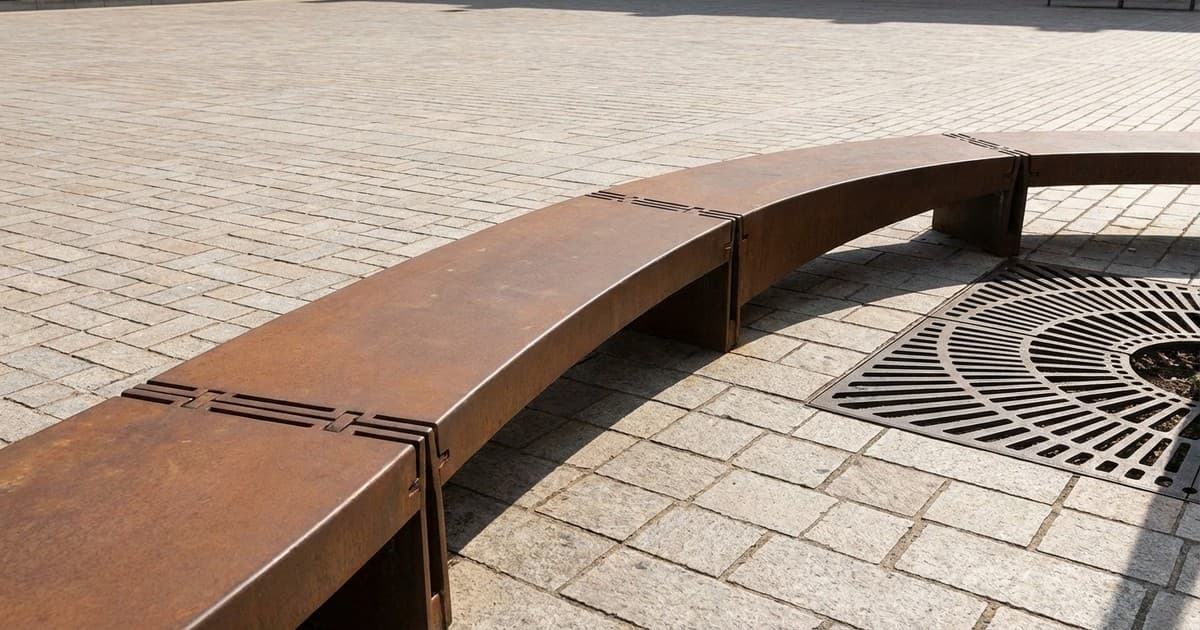
Not all design details are meant to be welcoming. Hostile architecture, or defensive design, uses subtle physical modifications to discourage certain behaviors. You might notice armrests placed in the middle of a park bench or small metal studs on flat concrete ledges. These are not merely decorative flourishes; they are specifically engineered to prevent people from lying down or skateboarding, quietly shaping how the public uses the space.
These interventions are often controversial, as they represent a form of social control built directly into the landscape. From slanted surfaces that make sitting uncomfortable for long periods to high-frequency sound emitters, these details define who is allowed to occupy a space and for how long. While they aim to maintain order, they also highlight the tensions inherent in urban planning and the management of public behavior.
The psychology of light and color
Lighting in public areas often does more than provide visibility at night. In many subway stations and tunnels, planners have experimented with blue-toned lighting rather than standard yellow or white bulbs. Research suggests these specific wavelengths can have a calming effect on the human nervous system, potentially reducing instances of crime or self-harm. By subtly altering the atmosphere, city planners use light as a non-verbal tool.
This psychological approach extends to the color of pavement and the placement of greenery. Studies have shown that even small patches of vegetation can lower heart rates and improve mental well-being in dense environments. These choices are calculated investments in public health, designed to mitigate the stresses of city life. The hue of a street lamp or the shade of a wall is rarely a matter of simple aesthetics; it is a choice rooted in behavioral science.
Wayfinding without the signs
Effective urban planning often relies on intuitive wayfinding that doesn't require a single signpost. Designers often use "desire lines"—the worn-down grass paths where people naturally walk—to decide where to pave new walkways. Similarly, changes in flooring material or ceiling height can signal transitions between public and private zones. These cues guide our subconscious, helping us navigate complex hubs like airports or transit plazas.
By aligning the physical environment with natural human movement, designers reduce the friction of daily travel. Even the orientation of a building's entrance or the placement of a focal point like a fountain serves as a landmark that helps people orient themselves. These details ensure that the city remains legible, allowing us to find our way through a labyrinth of concrete and steel with minimal cognitive effort.
The modern city is a masterpiece of intentionality, where even the smallest bolt or tile serves a specific purpose. By paying closer attention to these hidden features, we gain a deeper appreciation for the work of architects and planners who craft our daily experiences. Whether it is a safety feature or a psychological nudge, the details of our environment prove that there is much more to our streets than meets the eye.